Product Overview
The DEC890 is a digital conductivity sensor built around a graphite two-electrode measuring cell, designed for continuous online monitoring of aqueous conductivity in remote, off-grid and hard-to-service locations. Its most distinctive engineering feature is the extremely low power demand: the complete sensor runs on a DC 9~36V wide voltage input and consumes only about 0.2W, so a small solar panel, a 12V/24V battery bank or a low-capacity DC power supply can keep it operating around the clock without any additional load on the control cabinet.
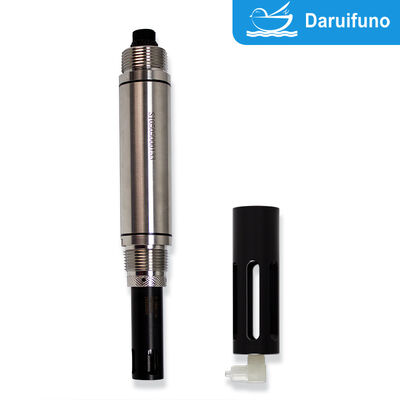
Two parallel graphite plates are placed in the solution and a driving voltage is applied across them; the conductivity of the solution is calculated from the current flowing between the plates. Because graphite is used instead of metal electrodes, the polarization effect that normally distorts electrochemical conductivity readings is greatly reduced, which keeps the signal stable over long immersion periods and in solutions with moderate fouling tendency. The measuring unit itself is a replaceable structure, so a damaged or heavily fouled electrode cell can be swapped in the field instead of replacing the whole sensor, which lowers long-term maintenance cost considerably.
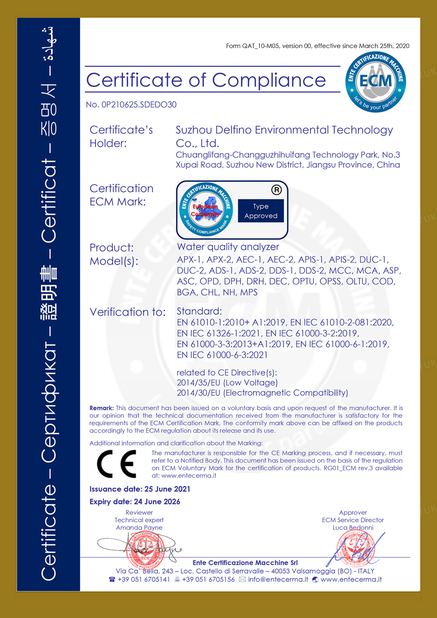
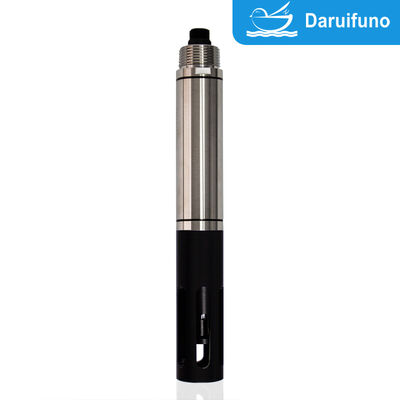
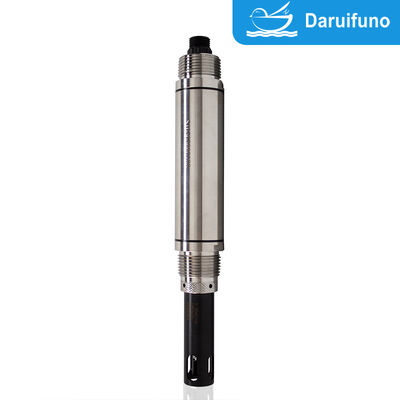
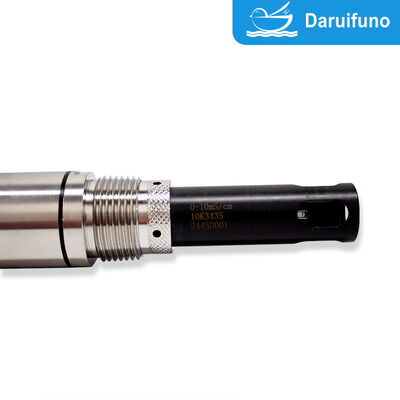
The sensor body combines a stainless steel 316 shaft with POM components, giving a slim 37mm diameter and a total length of about 261mm. Both ends are machined with 1-inch NPT threads, so the sensor can be screwed into a standard pipe tee, a flange adapter or a submersible bracket without any special tooling. The sealed construction reaches IP68, and the power supply and the RS485 communication line are electrically isolated, which prevents ground loops and protects the communication electronics in plants where sensors share a common power rail with pumps, VFDs and dosing equipment.
Design & Performance
The DEC890 digital conductivity sensor is aimed at system integrators and plant operators who need dependable conductivity data from sites where power is scarce and maintenance visits are expensive. Typical examples are solar powered surface water stations, battery backed well and reservoir monitoring, remote aquaculture ponds, irrigation canals and decentralized sewage treatment stations. In all of these cases the 0.2W power consumption combined with the wide DC 9~36V input range removes the need for a dedicated power supply design: the sensor can be connected directly to the same 12V or 24V DC bus that feeds the data logger, the RTU or the small solar charge controller.
Measurement performance is defined by four factory ranges — 0~20uS/cm, 20~200uS/cm, 200~2000uS/cm and 2~10mS/cm — with resolution down to 0.01uS/cm and an accuracy of ±1% of the selected measuring range. Temperature is measured simultaneously from 0.0 to 50.0°C with 0.1°C resolution, and temperature compensation can be set to automatic or manual across the full 0~50°C span, so readings are always referenced to a comparable basis regardless of seasonal water temperature changes. For low-conductivity applications such as purified water and condensate, the 0.01uS/cm resolution makes small drift visible long before it becomes a quality problem.
Communication follows RS485 MODBUS-RTU with the factory default address 17, 9600bps, no parity and one stop bit. Measured values are transmitted as 4-byte floating point data in little-endian byte-swapped order, and the register map in the manual allows the master device to read conductivity and temperature, change the Modbus address, adjust baud rate, and write calibration factors. Because power and communication are isolated, the same RS485 bus can safely be shared with other digital sensors on a long cable run, which is exactly the architecture used by solar powered monitoring stations that poll several probes from a single data logger.
Calibration is flexible: offset calibration, factor calibration and multi-point calibration are all supported, with up to five calibration points. In normal service a two-point calibration with two water samples of known conductivity is sufficient; when the sensor is moved to a different measuring range or the replaceable measuring head is exchanged, a multi-point calibration with 84uS/cm, 146uS/cm, 1413uS/cm and 12880uS/cm standard solutions restores full accuracy. Calibration parameters can always be reset to the factory state by writing a single value to the reset register, which is useful when a site is handed over to a new operator.
Mechanically, the DEC890 is built for long immersion. The stainless steel 316 body resists corrosion in fresh water and many process streams, while the POM end pieces insulate the electrode assembly from the housing. The 1-inch NPT threads at both ends accept standard fittings for side wall mounting, top flange mounting, pipeline installation, submerged installation and flow-through installation. A standard 10m shielded cable with an M16 connector is supplied, and longer cable lengths are available on request for deep tanks or remote wells.
Technical Parameters
| Measuring Principle | Graphite two-electrode measurement principle (polarization-resistant graphite plates) |
|---|
| Measuring Range | 0~20uS/cm / 20~200uS/cm / 200~2000uS/cm / 2~10mS/cm (switchable models) |
|---|
| Resolution | 0.01uS/cm, 0.1uS/cm, 1uS/cm |
|---|
| Accuracy | ±1% of the measuring range |
|---|
| Temperature Range | 0.0~50.0°C |
|---|
| Temperature Compensation | 0~50°C, automatic or manual compensation |
|---|
| Calibration Methods | Offset calibration, factor calibration, multi-point calibration (up to 5 points) |
|---|
| Operating Temperature | 0 to 50°C |
|---|
| Working Pressure | 0~1 Bar |
|---|
| Waterproof Level | IP68, continuous immersion rated |
|---|
| Power Requirements | DC 9~36V wide voltage input |
|---|
| Power Consumption | About 0.2W |
|---|
| Electrical Isolation | Power supply and communication are electrically isolated |
|---|
| Communication Interface | RS485 MODBUS-RTU (default address 17, 9600bps, no parity, 1 stop bit) |
|---|
| Housing Material | Stainless steel 316 + POM |
|---|
| Dimension | Diameter 37mm, total length about 261mm |
|---|
| Process Connection | 1-inch NPT thread at both ends |
|---|
| Cable | Standard 10 meters, length can be customized |
|---|
| Connector | M16 |
|---|
Key Advantages
- 0.2W ultra low power consumption. The complete sensor needs only about 0.2W, making it practical to run from a small solar panel, a 12V/24V battery or a limited DC supply in off-grid monitoring stations.
- DC 9~36V wide voltage input. The sensor tolerates large supply fluctuations and can be connected directly to the same DC bus as loggers, RTUs and solar charge controllers without an extra converter.
- Graphite two-electrode cell. Graphite plates suppress polarization effects, keeping conductivity readings stable over long immersion periods and reducing drift compared with bare metal electrodes.
- IP68 sealing with isolated power and communication. Continuous immersion protection plus electrical isolation between supply and RS485 prevent ground loops and protect the electronics in shared-power installations.
- Replaceable measuring head. A fouled or damaged electrode cell can be exchanged in the field instead of replacing the entire sensor, which cuts maintenance and spare-part cost.
- Four ranges with 0.01uS/cm resolution. A single sensor family covers purified water, drinking water, wastewater and brackish water, with accuracy of ±1% of range and fine resolution at the low end.
- Stainless steel 316 and POM housing. A corrosion-resistant 316 shaft with insulating POM parts survives long-term immersion in fresh and many process waters.
- Flexible calibration and reset. Offset, factor and multi-point calibration up to five points, with a one-command reset to factory calibration when a site is recommissioned.
Applications
The DEC890 suits any application where conductivity must be tracked continuously and power is limited. Because the measuring range can be selected at ordering, the same sensor platform serves both very dilute and moderately concentrated solutions.
- Solar powered surface water stations. Rivers, lakes and reservoirs monitored from a pole-mounted solar panel and battery, with the sensor reporting conductivity and temperature over RS485 to a low-power logger.
- Remote well and reservoir monitoring. Groundwater wells, hilltop reservoirs and irrigation canals where no mains power is available and maintenance visits are infrequent.
- Decentralized sewage treatment. Small rural or industrial wastewater stations, aeration tanks and outlet channels where conductivity is used as a proxy for dissolved solids loading.
- Aquaculture and fishery water. Pond and cage farms that need continuous salinity and conductivity tracking to protect stock during rainfall and water exchange events.
- Drinking water plants and water stations. Raw water and finished water monitoring where low-conductivity resolution down to 0.01uS/cm is required.
- Industrial process water. Cooling water, rinse water and boiler make-up lines in metallurgy, electronics, mining and paper plants where the isolated RS485 bus integrates easily with existing PLC and SCADA systems.
Installation and Wiring
Five mounting arrangements are supported by the dual 1-inch NPT threaded body: side wall installation, top flange mounting, pipeline installation, submerged installation and flow-through installation. For pipeline work the sensor should sit at a low point of the run where the flow is steady and bubbles are not easily generated; for submerged use the front section should face the direction of the water flow and be pushed well into the moving body of water so that the electrode plates are continuously swept.
Keep the measuring part clean during installation. Do not touch the electrode surfaces with bare hands or dirty objects, and avoid any contact with oily or adhesive substances, which can bias the reading for a long period and require re-calibration. Never route the sensor cable in the same conduit as power cables: induced interference can disturb the conductivity signal, and damaged insulation on a shared conduit can break down the measuring circuit.
Wiring uses four conductors: red for power positive (V+), black for power negative (V-), white for RS485 data A (+) and green for RS485 data B (-). The aviation plug version is supplied pre-wired and needs no field termination. The default communication parameters are address 17, 9600bps, no parity, one stop bit; they can be changed through the Modbus register map described in the manual before the sensor is added to an existing bus.
Note: the sensor contains precision measuring parts and no user-serviceable components inside. Avoid strong mechanical impact during transport and installation, and do not open the housing.
Calibration and Maintenance
The sensor offers offset calibration, factor calibration, two-point calibration and multi-point calibration. Two-point calibration uses the relationship "conductivity = (original value + offset) * factor" and needs only two water samples of known conductivity: record the reading in each sample after the value stabilizes and bubbles are removed by gentle shaking, then calculate the factor and offset from the two pairs of values and write them to the registers. This is normally enough for routine maintenance.
Multi-point calibration is used when the deviation is large or the measuring head has been replaced. Standard solutions of 84uS/cm, 146uS/cm, 1413uS/cm and 12880uS/cm are measured in sequence, with the sensor rinsed in deionized water and blotted dry between steps, and each reference value is written to its dedicated register. Up to five points are supported, and calibration at 25°C avoids the small error introduced by temperature compensation.
Maintenance is simple: a monthly visual inspection, a monthly calibration check depending on the environment, and seal maintenance every two years. Routine cleaning is done by shaking the sensor in clean water; heavily contaminated measuring surfaces can be soaked in a mild detergent or weak acid for about 15 minutes and then rinsed with distilled water. Never use hard objects on the electrode surface and never wipe it, otherwise the measurement will drift and require re-calibration.
Frequently Asked Questions
Q: How much power does the DEC890 need in a solar powered station?
A: Only about 0.2W. With a DC 9~36V input it can run directly from a 12V or 24V battery charged by a small solar panel, and the isolated RS485 output lets it share the bus with a low-power logger.
Q: Can I use one sensor for both pure water and wastewater?
A: The DEC890 is available in four ranges: 0~20uS/cm, 20~200uS/cm, 200~2000uS/cm and 2~10mS/cm. Select the range that brackets your expected conductivity; the 0.01uS/cm resolution version suits purified water, while the 2~10mS/cm version suits process water.
Q: What does IP68 mean for this sensor?
A: The housing is sealed for continuous immersion and the connector is rated for wet environments, so the sensor can be installed submerged in tanks, channels and wells rather than only in a bypass line.
Q: Which communication protocol does it use?
A: RS485 MODBUS-RTU with factory defaults of address 17, 9600bps, no parity, one stop bit. Values are transmitted as 4-byte floating point data in little-endian byte-swapped order, and the address and baud rate can be changed through the registers.
Q: How often should the sensor be calibrated?
A: A monthly calibration check is recommended, with the interval adjusted to the fouling tendency of the water. Two-point calibration is sufficient for routine checks; multi-point calibration is required after replacing the measuring head or changing the measuring range.
Q: Is the measuring head replaceable?
A: Yes. The measurement unit is a replaceable structure, so a worn or fouled electrode cell can be exchanged without scrapping the stainless steel housing, which reduces spare-part cost.
Q: Can the cable be longer than 10 meters?
A: A 10-meter shielded cable with M16 connector is standard and longer lengths are available on request for deep wells or long pipeline runs. Keep the cable away from power lines to avoid interference.
Q: What is the maximum working pressure?
A: 0~1 Bar, and the operating temperature range is 0~50°C. For higher pressures or temperatures please contact us to confirm a suitable alternative.
Ordering and Packaging Information
Every DEC890 conductivity sensor is supplied as a complete, ready-to-commission package: one graphite two-electrode digital conductivity sensor, one 10-meter shielded RS485 cable with M16 connector, a printed basic user manual (Model DEC890, Version 1.0), and a calibration certificate traceable to standard conductivity solutions. Cable length can be customized for large tanks, deep wells and long pipeline runs.
Sensors are packed individually in shock-proof foam inside export-grade corrugated cartons, with the measuring head protected by a dedicated cap that keeps the graphite electrode plates wet and free from mechanical damage during transport. Please state the required measuring range, cable length and connector type when ordering so that the factory can pre-configure the Modbus address and communication parameters before shipment.


 Your message must be between 20-3,000 characters!
 English