DEC890 Cooling Tower Conductivity Sensor Blowdown Control 2000uS/cm RS485 Modbus Water Treatment
In a cooling tower, conductivity is the control variable that decides how much water is bled to drain. Run too low and the plant wastes water and chemical; run too high and scale and corrosion take hold in the heat exchanger. The DEC890 measures the 200~2000 uS/cm band that covers most circulating water programmes with plus or minus 1 percent of range accuracy, and reports it over RS485 so the blowdown valve can be driven automatically instead of by a timer.
Product Overview
Because cycles of concentration are calculated from the ratio between make-up and circulating conductivity, both readings must be trustworthy and taken at the same temperature reference. The sensor compensates automatically from 0 to 50 C, and its graphite cell resists the scaling and biofilm that attack metal electrodes in warm circulating water. Isolated power and communication keep the signal clean next to the cooling tower fans and pumps, where electrical noise is high and cable runs are long.
Key Advantages
- 200~2000 uS/cm working band matches typical cooling water cycles of concentration without range switching.
- Automatic 0~50 C compensation makes the reading comparable to make-up water and to lab reference checks.
- Graphite two-electrode cell resists scale and biofilm in warm circulating water better than metal plates.
- RS485 Modbus-RTU output drives blowdown valves, dosing pumps and BMS logic directly.
- Isolated power and communication suppress noise from tower fans, pumps and VFDs on long cable runs.
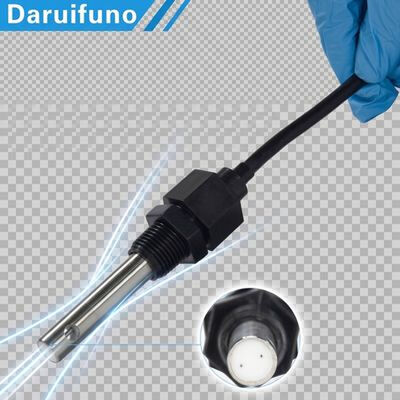
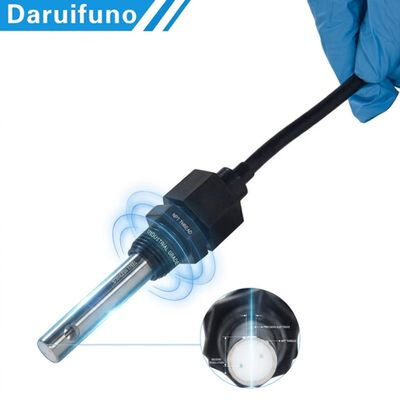
- IP68 stainless steel 316 and POM body permits side wall, pipeline and flow-through mounting in the basin or return line.
- Four ranges available, so the same part number serves make-up, circulating and blowdown points.
Technical Specifications
| Measuring principle | Graphite two-electrode measurement principle |
|---|
| Measuring range | 0~20 µS/cm, 20~200 µS/cm, 200~2000 µS/cm, 2~10 mS/cm |
|---|
| Resolution | 0.01 µS/cm, 0.1 µS/cm, 1 µS/cm; temperature 0.1 °C |
|---|
| Accuracy | ±1% of the measuring range |
|---|
| Temperature compensation | 0~50 °C, automatic or manual |
|---|
| Calibration | Offset, factor and multi-point calibration up to 5 points |
|---|
| Operating temperature | 0 to 50 °C |
|---|
| Working pressure | 0~1 Bar |
|---|
| Waterproof level | IP68 |
|---|
| Power supply | DC 9~36 V, about 0.2 W |
|---|
| Electrical isolation | Power supply and communication isolated |
|---|
| Communication | RS485 Modbus-RTU, address 17, 9600 bps, no parity, 1 stop bit |
|---|
| Housing material | Stainless steel 316 and POM |
|---|
| Dimensions | Diameter 37 mm, total length about 261 mm |
|---|
| Process connection | 1 inch NPT thread at both ends |
|---|
| Cable | 10 m shielded cable standard, customizable |
|---|
| Connector | M16, aviation plug version available |
|---|
| Typical working range | 200~2000 uS/cm circulating water |
|---|
| Control use | Blowdown setpoint and cycles of concentration |
|---|
Applications
- Cooling tower circulating water and blowdown automation
- Chiller condenser water and closed loop monitoring
- HVAC plant water treatment and chemical dosing control
- Power plant cooling water and auxiliary circuits
- Steel and chemical plant recirculating cooling systems
- Data centre cooling water quality monitoring
Installation, Wiring and Maintenance
Install at a stable, bubble free point of the pipe or submerge the probe with its measuring front end facing the flow. Keep the signal cable out of power conduits, because induced interference degrades a low level conductivity signal before it reaches the controller. Wiring is red to V+, black to V-, white to RS485 A (AS) and green to RS485 B (BS); the aviation plug version is factory terminated and needs no field wiring. Routine cleaning is a rinse and shake in clean water; heavy fouling can be soaked off in a light detergent or weak acid for 15 minutes, then rinsed with distilled water. Never touch or wipe the graphite electrode, and verify calibration monthly when the medium is aggressive.
FAQ
Q1. Which range should I use for cooling water?
A: Most programmes run between 200 and 2000 uS/cm, which is one of the four selectable ranges. Confirm the target cycles of concentration with your water treatment supplier before setting the blowdown setpoint.
Q2. Can the sensor drive the blowdown valve directly?
A: It provides the measurement over RS485 Modbus-RTU. The controller or BMS compares it with the setpoint and commands the valve, which keeps the control logic in one place.
Q3. How often should the probe be cleaned?
A: Monthly visual inspection and a rinse are normally enough. If scale or biofilm builds up, soak the measuring section in a weak acid for 15 minutes, then rinse with distilled water.
Q4. Will temperature changes cause false blowdown?
A: No. Compensation from 0 to 50 C is automatic, so a warm afternoon does not look like a rise in dissolved solids.
Q5. Is the reading affected by the tower fans?
A: Power and communication are isolated, and the digital RS485 output is far less susceptible to the electrical noise generated by fans and VFDs than an analogue loop.
Q6. Can I monitor make-up water with the same probe?
A: Yes. The 0~20 or 20~200 uS/cm ranges handle make-up and soft water, so one part number covers the whole water balance.
Ordering Information
Delivery includes the sensor, a 10 m shielded cable, a printed manual and export packaging with shock proof foam. Cable length, connector, thread, range configuration and branding are customizable. Confirm your medium, conductivity span and mounting style when ordering and we will pre-set the range and communication registers before dispatch, so the unit works as soon as it is powered.
Send your medium and expected range today, and our engineers will reply with a matching configuration and quotation within one working day.


 Your message must be between 20-3,000 characters!
 English