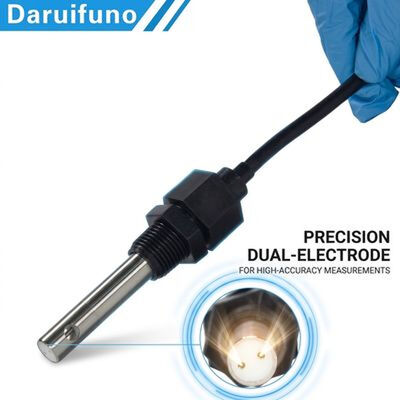
DEC890 Graphite Electrode Conductivity Sensor Anti Polarization Design Mining Chemical Paper Industry
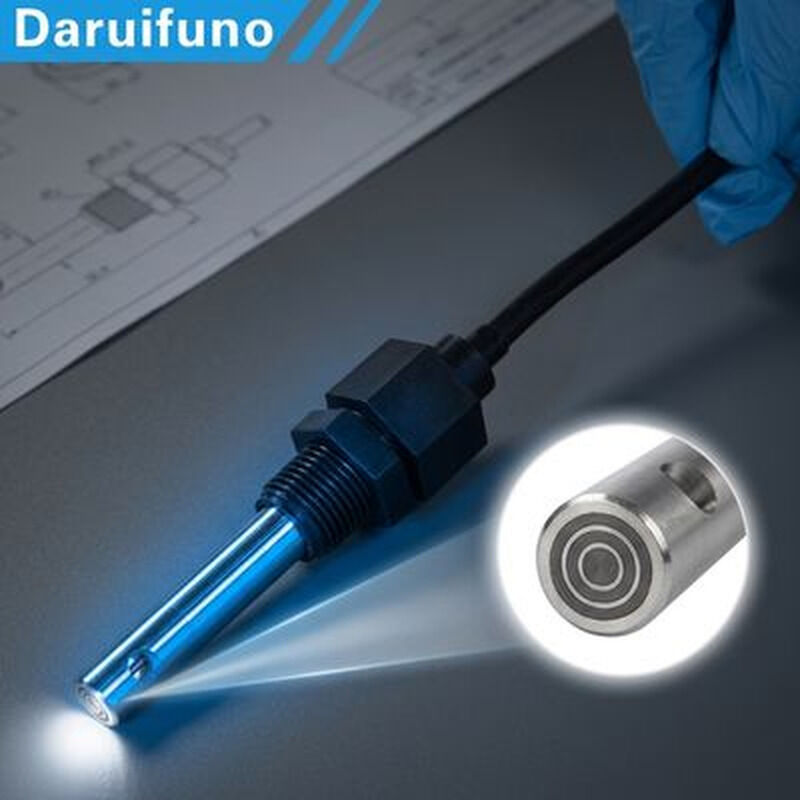
In aggressive liquids the limiting factor of a conductivity measurement is rarely the electronics; it is the electrode. Metal plates polarise under a driving voltage and then foul, and the reading drifts within weeks. The DEC890 uses graphite plates, which suppress polarisation and tolerate the scaling, grease and fibre loading typical of mining, chemical and paper industry liquors, so the sensor keeps measuring long after a metal electrode would have been pulled for cleaning.
Product Overview
Graphite is chemically inert across the pH range found in process water and does not form the oxide films that shift the cell constant of stainless steel or platinum electrodes. Combined with the two-electrode measuring principle and a fixed graphite geometry, the cell constant stays stable, which means fewer calibrations and a longer interval between maintenance visits. The replaceable head further reduces cost when the electrode eventually does wear in an abrasive slurry.
Key Advantages
- Graphite electrode plates suppress polarisation, keeping the reading stable in high solids and high salinity media.
- Chemically inert cell tolerates acidic and alkaline process liquors without oxide film formation.
- Stable cell constant reduces calibration frequency, cutting maintenance labour in remote plant areas.
- IP68 stainless steel 316 and POM housing survives wash-down, temporary flooding and buried installation.
- Four ranges from 0~20 uS/cm to 2~10 mS/cm cover dilute rinse water and saturated process brine.
- RS485 Modbus-RTU with isolated power and communication is immune to the electrical noise of smelters and large drives.
- Replaceable measuring head keeps the body, cable and fitting reusable when the electrode finally wears.
Technical Specifications
| Measuring principle | Graphite two-electrode measurement principle |
|---|
| Measuring range | 0~20 µS/cm, 20~200 µS/cm, 200~2000 µS/cm, 2~10 mS/cm |
|---|
| Resolution | 0.01 µS/cm, 0.1 µS/cm, 1 µS/cm; temperature 0.1 °C |
|---|
| Accuracy | ±1% of the measuring range |
|---|
| Temperature compensation | 0~50 °C, automatic or manual |
|---|
| Calibration | Offset, factor and multi-point calibration up to 5 points |
|---|
| Operating temperature | 0 to 50 °C |
|---|
| Working pressure | 0~1 Bar |
|---|
| Waterproof level | IP68 |
|---|
| Power supply | DC 9~36 V, about 0.2 W |
|---|
| Electrical isolation | Power supply and communication isolated |
|---|
| Communication | RS485 Modbus-RTU, address 17, 9600 bps, no parity, 1 stop bit |
|---|
| Housing material | Stainless steel 316 and POM |
|---|
| Dimensions | Diameter 37 mm, total length about 261 mm |
|---|
| Process connection | 1 inch NPT thread at both ends |
|---|
| Cable | 10 m shielded cable standard, customizable |
|---|
| Connector | M16, aviation plug version available |
|---|
| Electrode material | Graphite plate, replaceable head |
|---|
| Typical fouling media | Slurry, scale, grease, fibre |
|---|
Applications
- Mining process water, tailings thickener overflow and slurry filtrate
- Chemical reactor wash water and acid or caustic dilution lines
- Pulp and paper white water, black liquor and recovery circuits
- Metallurgy pickling rinse and electroplating drag-out recovery
- Industrial effluent neutralisation and discharge monitoring
- Aggressive cooling water and scrubber blowdown
Installation, Wiring and Maintenance
Install at a stable, bubble free point of the pipe or submerge the probe with its measuring front end facing the flow. Keep the signal cable out of power conduits, because induced interference degrades a low level conductivity signal before it reaches the controller. Wiring is red to V+, black to V-, white to RS485 A (AS) and green to RS485 B (BS); the aviation plug version is factory terminated and needs no field wiring. Routine cleaning is a rinse and shake in clean water; heavy fouling can be soaked off in a light detergent or weak acid for 15 minutes, then rinsed with distilled water. Never touch or wipe the graphite electrode, and verify calibration monthly when the medium is aggressive.
FAQ
Q1. Why graphite instead of stainless steel electrodes?
A: Graphite minimises the polarisation effect that shifts metal electrode readings and it resists the oxide films that form in acidic or oxidising media, so the cell constant stays stable far longer.
Q2. Will the sensor survive abrasive slurry?
A: The body is stainless steel 316 and the cell is graphite, both suitable for slurry service. Abrasion eventually wears any electrode, but the replaceable head keeps that repair inexpensive.
Q3. What accuracy can I expect in dirty media?
A: The specified accuracy is plus or minus 1 percent of range under calibration conditions. Heavy fouling adds error until cleaned, which is why a monthly calibration check is recommended in aggressive duty.
Q4. Is the sensor affected by plant electrical noise?
A: Power and communication are electrically isolated and the output is digital RS485, which removes the ground loop problems common near smelters, rectifiers and large drives.
Q5. How do I clean a scaled electrode?
A: Soak the measuring section in a light detergent or weak acid for 15 minutes, then rinse with distilled water. Never scrape or wipe the graphite surface.
Q6. Can I use one model across several process lines?
A: Yes. Four ranges are register selectable, so a plant can standardise on one part number and configure each point for its own span.
Ordering Information
Delivery includes the sensor, a 10 m shielded cable, a printed manual and export packaging with shock proof foam. Cable length, connector, thread, range configuration and branding are customizable. Confirm your medium, conductivity span and mounting style when ordering and we will pre-set the range and communication registers before dispatch, so the unit works as soon as it is powered.
Send your medium and expected range today, and our engineers will reply with a matching configuration and quotation within one working day.


 Your message must be between 20-3,000 characters!
 English