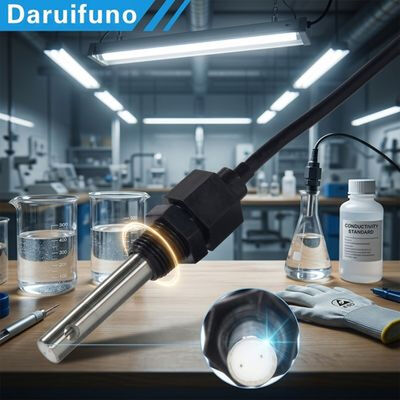
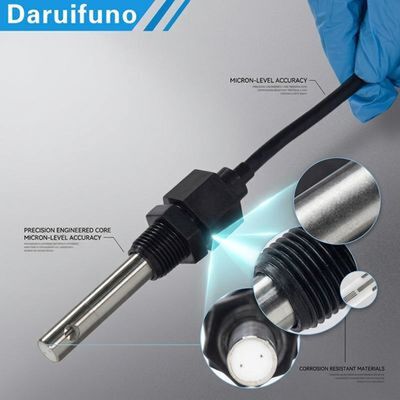
DEC890 TDS Salinity Conductivity Probe 0-2000uS/cm 10mS/cm Four Range Auto Temperature Compensation RS485
Salinity and total dissolved solids are both derived from conductivity, but the measurement challenge differs sharply between a 20 uS/cm river sample and a 10 mS/cm brine line. The DEC890 covers that entire span with four hardware ranges in one body, and applies automatic temperature compensation across 0 to 50 C so that a change in water temperature is not mistaken for a change in dissolved salt content. That combination makes one model number usable from freshwater intake through to seawater and industrial brine.
Product Overview
The probe reports raw conductivity over RS485, and the controller or SCADA layer converts it to TDS or salinity using the site specific factor, which keeps the sensor itself calibration-stable and lets one instrument serve several reporting conventions. For environmental monitoring stations that must report both conductivity and TDS, this avoids installing two separate probes at the same point and removes the inconsistency that arises when two instruments drift apart.
Key Advantages
- Four hardware ranges cover 0~20 uS/cm, 20~200 uS/cm, 200~2000 uS/cm and 2~10 mS/cm, from freshwater to brine.
- Automatic or manual temperature compensation across 0~50 C prevents temperature swings from being read as salinity changes.
- Up to 5 point calibration with 84, 146, 1413 and 12880 uS/cm standards delivers traceable accuracy across the full span.
- Graphite two-electrode cell resists polarisation in high salinity media where metal electrodes drift.
- IP68 stainless steel 316 and POM housing allows submerged, pipeline and flow-through installation with 1 inch NPT fittings.
- RS485 Modbus-RTU with isolated power and communication integrates directly with RTU, datalogger and cloud gateways.
- 0.01 uS/cm resolution in the low range keeps the same probe usable for dilute stream water and concentrated brine.
Technical Specifications
| Measuring principle | Graphite two-electrode measurement principle |
|---|
| Measuring range | 0~20 µS/cm, 20~200 µS/cm, 200~2000 µS/cm, 2~10 mS/cm |
|---|
| Resolution | 0.01 µS/cm, 0.1 µS/cm, 1 µS/cm; temperature 0.1 °C |
|---|
| Accuracy | ±1% of the measuring range |
|---|
| Temperature compensation | 0~50 °C, automatic or manual |
|---|
| Calibration method | Offset calibration, factor calibration, multi-point calibration (up to 5 points) |
|---|
| Operating temperature | 0 to 50 °C |
|---|
| Working pressure | 0~1 Bar |
|---|
| Waterproof level | IP68 |
|---|
| Power supply | DC 9~36 V, about 0.2 W |
|---|
| Electrical isolation | Power supply and communication isolated |
|---|
| Communication | RS485 Modbus-RTU, address 17, 9600 bps, no parity, 1 stop bit |
|---|
| Housing material | Stainless steel 316 and POM |
|---|
| Dimensions | Diameter 37 mm, total length about 261 mm |
|---|
| Process connection | 1 inch NPT thread at both ends |
|---|
| Cable | Standard 10 m shielded cable, customizable |
|---|
| Connector | M16 |
|---|
| Range switching | Register configurable, four hardware ranges |
|---|
| Typical TDS factor | 0.5 to 0.7 depending on site convention |
|---|
Applications
- River, lake and reservoir salinity and TDS monitoring
- Seawater intrusion and estuary surveillance
- Brine, pickling and mineral processing liquors
- Agricultural irrigation water salinity control
- Aquaculture pond and hatchery water quality
- Industrial effluent TDS compliance reporting
Installation, Wiring and Maintenance
Mount the sensor where the flow is stable and bubbles are not easily generated, or submerge it with the measuring front end facing the flowing water. The cable must never be routed in the same conduit as power lines, otherwise measurement interference or cable damage may occur. Wiring is simple: red is power positive (V+), black is power negative (V-), white is RS485 A (AS) and green is RS485 B (BS); the aviation plug version requires no field wiring at all. Keep the electrode surface free of oil and grease, rinse with clean water for routine cleaning, and soak in a light detergent or weak acid for 15 minutes when fouling is heavy. Never wipe the electrode with a hard object, otherwise the sensor must be recalibrated.
FAQ
Q1. Can one probe really measure both 20 uS/cm and 10 mS/cm?
A: Yes. The sensor provides four hardware ranges and switches between them by register configuration, with 0.01 uS/cm resolution at the low end and 1 uS/cm at the high end.
Q2. How is TDS calculated from the reading?
A: The probe reports conductivity. The controller or SCADA multiplies it by the site specific TDS factor, typically 0.5 to 0.7, so the same sensor can serve several reporting conventions.
Q3. Is temperature compensation automatic?
A: Compensation from 0 to 50 C can run automatically or manually, and a temperature deviation value can be written to correct any residual offset.
Q4. What happens if the probe is used in seawater?
A: The 2~10 mS/cm range covers typical seawater, and the graphite cell resists the polarisation and fouling that degrade metal electrodes in high salinity media.
Q5. Which calibration standards should I prepare?
A: 84, 146, 1413 and 12880 uS/cm standard solutions cover the full span. Calibrate at 25 C where possible to avoid a small compensation error.
Q6. Can the probe be submerged permanently?
A: Yes, the housing is IP68 and rated to 0~1 Bar, with submerged, side wall, flange and flow-through mounting options.
Ordering Information
Every unit is supplied with a shock-proof foam insert, export carton, 10 m shielded cable and a printed user manual. Cable length, connector type, thread specification, measuring range configuration and private label packaging can be customized. Please confirm the medium, expected conductivity span and mounting method when ordering, and our engineers will pre-configure the register settings before shipment. Technical support covers commissioning, Modbus register mapping and calibration training.
Tell us your medium and range, and we will send a ready-to-install configuration and quotation within one working day.


 Your message must be between 20-3,000 characters!
 English