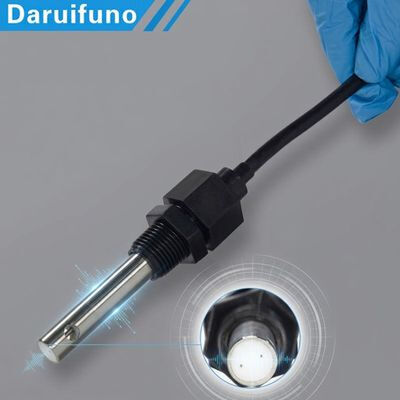
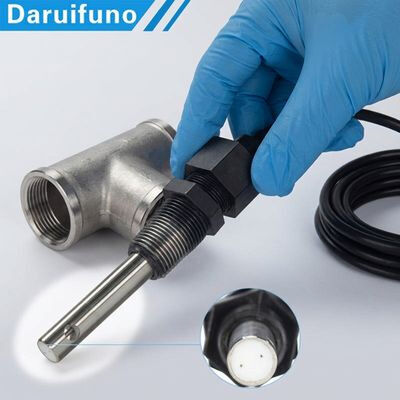
DEC890 Flow Through Conductivity Sensor 1 Inch NPT Pipeline Mounting Stainless Steel 316 IP68 RS485 Output
The DEC890 flow-through configuration is built for plants that measure conductivity inside a pressurised pipeline or a bypass loop. The stainless steel 316 body carries a 1 inch NPT thread at both ends, so the sensor is simply screwed into a tee, a bypass rack or a sample panel instead of being lowered into an open basin. Water passes the graphite cell continuously, giving a live conductivity trend without manual sampling, and the IP68 sealing keeps the electronics safe even when the joint is weeping or the line is washed down.
Product Overview
Flow-through installation removes the two most common failure modes of immersion probes: cable strain from a swinging handrail mount, and silt or biofilm accumulation on a stagnant electrode. Because the cell sits in the moving stream, the reading responds within seconds to a process change, which makes this version the preferred choice for demineraliser outlet, boiler make-up, cooling water and CIP return lines where conductivity is used as a control signal rather than a periodic record.
Key Advantages
- 1 inch NPT thread at both ends screws directly into standard tees, bypass racks and sample panels without custom adapters.
- Flow-through design keeps the graphite cell in continuous contact with moving water, so response to process changes is immediate.
- Stainless steel 316 and POM body with IP68 sealing tolerates pressurised lines up to 1 Bar and routine wash-down.
- Graphite two-electrode cell reduces polarisation and organic fouling compared with exposed metal electrodes.
- RS485 Modbus-RTU output with isolated power and communication connects straight to PLC, DCS and SCADA without a separate transmitter.
- Four measuring ranges from 0~20 uS/cm to 2~10 mS/cm cover make-up water, cooling water and brine loops with one spare part number.
- 10 m shielded cable with M16 connector, aviation plug option available for wiring-free replacement in the field.
Technical Specifications
| Measuring principle | Graphite two-electrode measurement principle |
|---|
| Measuring range | 0~20 µS/cm, 20~200 µS/cm, 200~2000 µS/cm, 2~10 mS/cm |
|---|
| Resolution | 0.01 µS/cm, 0.1 µS/cm, 1 µS/cm; temperature 0.1 °C |
|---|
| Accuracy | ±1% of the measuring range |
|---|
| Temperature compensation | 0~50 °C, automatic or manual |
|---|
| Calibration method | Offset calibration, factor calibration, multi-point calibration (up to 5 points) |
|---|
| Operating temperature | 0 to 50 °C |
|---|
| Working pressure | 0~1 Bar |
|---|
| Waterproof level | IP68 |
|---|
| Power supply | DC 9~36 V, about 0.2 W |
|---|
| Electrical isolation | Power supply and communication isolated |
|---|
| Communication | RS485 Modbus-RTU, address 17, 9600 bps, no parity, 1 stop bit |
|---|
| Housing material | Stainless steel 316 and POM |
|---|
| Dimensions | Diameter 37 mm, total length about 261 mm |
|---|
| Process connection | 1 inch NPT thread at both ends |
|---|
| Cable | Standard 10 m shielded cable, customizable |
|---|
| Connector | M16 |
|---|
| Typical installation | Tee fitting, bypass rack or sample panel |
|---|
| Recommended flow condition | Stable flow, no entrapped air |
|---|
Applications
- Demineraliser and RO permeate outlet lines
- Boiler make-up water and condensate monitoring
- Cooling tower circulating water and blowdown control
- CIP return line concentration verification in food and beverage plants
- Semiconductor and electronics process water distribution loops
- Chemical dilution and dosing skids with inline verification
Installation, Wiring and Maintenance
Mount the sensor where the flow is stable and bubbles are not easily generated, or submerge it with the measuring front end facing the flowing water. The cable must never be routed in the same conduit as power lines, otherwise measurement interference or cable damage may occur. Wiring is simple: red is power positive (V+), black is power negative (V-), white is RS485 A (AS) and green is RS485 B (BS); the aviation plug version requires no field wiring at all. Keep the electrode surface free of oil and grease, rinse with clean water for routine cleaning, and soak in a light detergent or weak acid for 15 minutes when fouling is heavy. Never wipe the electrode with a hard object, otherwise the sensor must be recalibrated.
FAQ
Q1. Can the sensor be installed directly in a pressurised pipe?
A: Yes, provided the line stays within 0~1 Bar working pressure. Use a tee or bypass rack with a 1 inch NPT port, and keep the measuring section fully wetted.
Q2. Which mounting orientation is recommended?
A: Install it at a low point of the pipeline where the flow is stable and bubbles are not easily generated. Avoid the top of a horizontal run where air pockets can collect.
Q3. Does flow-through mounting affect accuracy?
A: No. Accuracy remains plus or minus 1 percent of range as long as the cell stays wetted and bubbles are avoided; the flowing stream actually improves response time.
Q4. What wiring do I need to provide?
A: Red is V+, black is V-, white is RS485 A and green is RS485 B. The aviation plug version needs no field wiring. Never route the signal cable in the same conduit as power lines.
Q5. How is the reading read by my control system?
A: Through RS485 Modbus-RTU, default address 17 at 9600 bps. The measurement is a 4-byte floating point value in little endian byte-swapped order.
Q6. Can I order a different thread or cable length?
A: Yes. Thread specification, cable length, connector type and private label packaging are all customizable for volume orders.
Ordering Information
Every unit is supplied with a shock-proof foam insert, export carton, 10 m shielded cable and a printed user manual. Cable length, connector type, thread specification, measuring range configuration and private label packaging can be customized. Please confirm the medium, expected conductivity span and mounting method when ordering, and our engineers will pre-configure the register settings before shipment. Technical support covers commissioning, Modbus register mapping and calibration training.
Tell us your medium and range, and we will send a ready-to-install configuration and quotation within one working day.


 Your message must be between 20-3,000 characters!
 English