DEC890 Submersible Conductivity Probe Stainless Steel 316 IP68 1 Inch NPT 0-50C Wastewater Monitoring
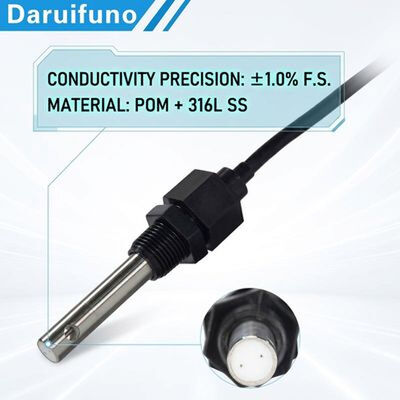
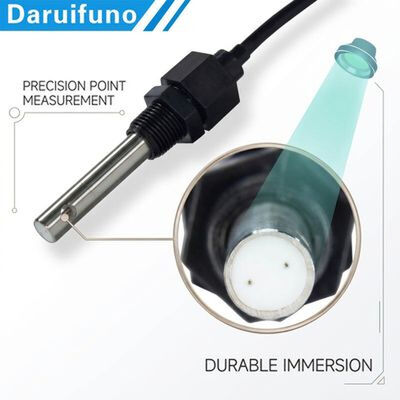
The DEC890 submersible conductivity probe is the immersion configuration of our digital conductivity platform. A stainless steel 316 and POM body with IP68 sealing allows the probe to stay continuously in sumps, channels, tanks and aeration basins, while the graphite two-electrode cell keeps the signal stable in biologically active wastewater. The 1 inch NPT thread at both ends accepts standard pipe fittings, so the same probe can be moved between submersed, side wall, flange and flow-through installations without special adapters.
Product Overview
This immersion version is the workhorse configuration for municipal and industrial water treatment, where probes are mounted on handrails, drop pipes or channel walls and must survive biofilm growth, sand and grease.
Key Advantages
- IP68 fully sealed stainless steel 316 body survives continuous immersion in sumps, channels and aeration basins.
- Graphite two-electrode cell reduces polarisation and fouling effects typical of wastewater with high suspended solids.
- Automatic 0~50 C temperature compensation keeps readings accurate when effluent temperature swings between shifts and seasons.
- 1 inch NPT thread at both ends allows submersible, side wall, top flange, pipeline and flow-through mounting with standard fittings.
- 10 m shielded cable supplied as standard, with customised lengths and an aviation plug option that requires no field wiring.
- Measuring head is replaceable, so only the electrode block is renewed instead of the whole probe.
- RS485 Modbus-RTU with isolated power and communication for direct connection to controllers, RTU and SCADA platforms.
Technical Specifications
| Measuring principle | Graphite two-electrode measurement principle |
|---|
| Measuring range | 0~20 µS/cm, 20~200 µS/cm, 200~2000 µS/cm, 2~10 mS/cm |
|---|
| Resolution | 0.01 µS/cm, 0.1 µS/cm, 1 µS/cm; temperature 0.1 °C |
|---|
| Accuracy | ±1% of the measuring range |
|---|
| Temperature compensation | 0~50 °C, automatic or manual compensation |
|---|
| Calibration method | Offset calibration, factor calibration, multi-point calibration (up to 5 points) |
|---|
| Operating temperature | 0 to 50 °C |
|---|
| Working pressure | 0~1 Bar |
|---|
| Waterproof level | IP68 |
|---|
| Power supply | DC 9~36 V, power consumption about 0.2 W |
|---|
| Electrical isolation | Power supply and communication are isolated |
|---|
| Communication interface | RS485 Modbus-RTU, default address 17, 9600 bps, no parity, 1 stop bit |
|---|
| Housing material | Stainless steel 316 and POM |
|---|
| Dimensions | Diameter 37 mm, total length about 261 mm |
|---|
| Process connection | 1 inch NPT thread at both ends |
|---|
| Cable | Standard 10 m shielded cable, length customizable |
|---|
| Connector | M16 |
|---|
| Typical immersion depth | Up to 1 Bar hydrostatic, 10 m standard cable |
|---|
Applications
- Wastewater treatment plant influent, aeration basin and final effluent monitoring
- Industrial effluent discharge compliance measurement
- Pump stations, equalisation tanks and storm water channels
- Surface water, reservoirs and aquaculture water quality stations
- Cooling tower circulating water and blowdown control
- Mining and metallurgy process water with high suspended solids
Installation and Maintenance Notes
Install the sensor at a stable, low-turbulence point of the pipeline where bubbles are not easily generated, or install it submerged with the measuring front end facing the water flow and deep into the moving water body. Keep the graphite electrode surface clean and never touch or wipe it with hard objects or oily materials, otherwise the reading will drift and recalibration will be required. The measuring unit is a replaceable structure, so the running cost of long-term monitoring stays low. Routine visual inspection and calibration verification are recommended monthly, and the seal should be serviced every two years.
FAQ
Q1. Can the probe stay in the water permanently?
A: Yes. With IP68 sealing and a stainless steel 316 housing the probe is designed for continuous immersion. Install it with the measuring front end facing the flow and deep enough in moving water to avoid silt build-up.
Q2. What is the maximum working pressure and temperature?
A: Working pressure is 0~1 Bar and the operating temperature range is 0 to 50 C, with automatic or manual compensation over the same range.
Q3. Will the cable be supplied with a connector?
A: A standard 10 m shielded cable is supplied, and an M16 connector or an aviation plug version is available. The aviation plug version needs no field wiring.
Q4. How should I clean a fouled probe?
A: Rinse and shake it in clean water. For heavy contamination soak the measuring section in a light detergent or weak acid for 15 minutes, then rinse with distilled water. Never wipe the electrode surface with a hard object.
Q5. Which output do I get for my PLC?
A: RS485 Modbus-RTU, default address 17 at 9600 bps, with 4-byte floating point measurement data in little endian byte-swapped order.
Q6. Do you support OEM branding and custom cable length?
A: Yes. Private label, custom cable lengths, thread specification and packaging are available for volume orders.
Ordering and Packaging
Each sensor is packed in a shock-proof foam insert with a corrugated export carton. The standard supply includes the sensor, 10 m cable and a user manual. Cable length, connector type, thread specification and private-label packaging can be customized; please confirm your range, mounting method and communication protocol when placing an order. Our engineers support commissioning, Modbus register mapping and calibration training.
Send your measurement range, medium and mounting method, and we will reply with a matching configuration and quotation within one working day.


 Your message must be between 20-3,000 characters!
 English