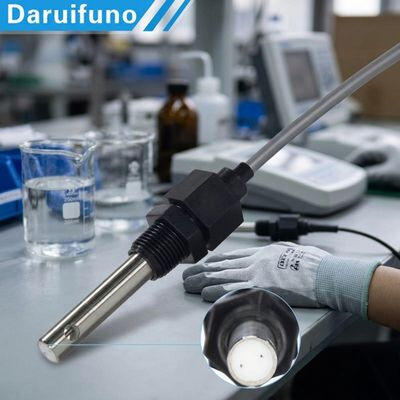
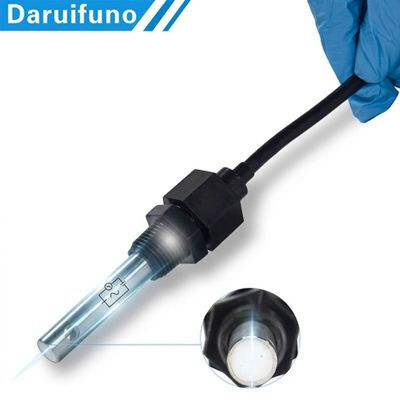
DEC890 Digital Conductivity Sensor Graphite Two Electrode 0-20uS/cm 2000uS/cm 10mS/cm RS485 Modbus IP68
The DEC890 is a digital conductivity sensor built on a graphite two-electrode measuring principle. Two parallel graphite plates are placed in the solution and a driving voltage is applied, so the conductivity value is calculated from the current intensity between the plates. Graphite minimises the polarisation effect that commonly limits metal electrodes, which keeps the reading stable in challenging water matrices. The measuring head is a replaceable structure, so maintenance cost over the service life of the instrument is significantly reduced.
Product Overview
The DEC890 is designed for continuous conductivity monitoring of aqueous solutions where a rugged, low-maintenance digital probe is required. Because the electrode block can be replaced on site, plants keep spares on the shelf instead of replacing the complete instrument.
Key Advantages
- Graphite two-electrode cell resists polarisation and keeps long-term readings stable in sewage, brine and surface water.
- Four switchable measuring ranges from 0~20 uS/cm up to 2~10 mS/cm cover clean water and high-salinity process liquids with one model.
- Accuracy of plus or minus 1 percent of range with 0.01 uS/cm resolution, suitable for both trend monitoring and compliance reporting.
- Digital RS485 Modbus-RTU output with isolated power and communication, drop-in compatible with PLC, DCS and SCADA systems.
- IP68 stainless steel 316 and POM housing with 1 inch NPT threads at both ends for side wall, flange, pipeline, submerged and flow-through mounting.
- Automatic or manual 0~50 C temperature compensation plus offset, factor and multi-point calibration for accurate results at real process temperature.
- Replaceable measuring head and standard 10 m shielded cable cut installation and lifecycle maintenance cost.
Technical Specifications
| Measuring principle | Graphite two-electrode measurement principle |
|---|
| Measuring range | 0~20 µS/cm, 20~200 µS/cm, 200~2000 µS/cm, 2~10 mS/cm |
|---|
| Resolution | 0.01 µS/cm, 0.1 µS/cm, 1 µS/cm; temperature 0.1 °C |
|---|
| Accuracy | ±1% of the measuring range |
|---|
| Temperature compensation | 0~50 °C, automatic or manual compensation |
|---|
| Calibration method | Offset calibration, factor calibration, multi-point calibration (up to 5 points) |
|---|
| Operating temperature | 0 to 50 °C |
|---|
| Working pressure | 0~1 Bar |
|---|
| Waterproof level | IP68 |
|---|
| Power supply | DC 9~36 V, power consumption about 0.2 W |
|---|
| Electrical isolation | Power supply and communication are isolated |
|---|
| Communication interface | RS485 Modbus-RTU, default address 17, 9600 bps, no parity, 1 stop bit |
|---|
| Housing material | Stainless steel 316 and POM |
|---|
| Dimensions | Diameter 37 mm, total length about 261 mm |
|---|
| Process connection | 1 inch NPT thread at both ends |
|---|
| Cable | Standard 10 m shielded cable, length customizable |
|---|
| Connector | M16 |
|---|
| Typical range selection | 0~20 uS/cm for pure water, 200~2000 uS/cm for surface water, 2~10 mS/cm for brine and seawater |
|---|
Applications
- Municipal sewage treatment plants and industrial effluent monitoring
- Drinking water plants, water stations and surface water surveillance
- Environmental water treatment and river basin monitoring stations
- Metallurgy, electronics and semiconductor rinse water control
- Mining process water and tailings conductivity monitoring
- Paper and pulp mill process water and recovery boiler circuits
Installation and Maintenance Notes
Install the sensor at a stable, low-turbulence point of the pipeline where bubbles are not easily generated, or install it submerged with the measuring front end facing the water flow and deep into the moving water body. Keep the graphite electrode surface clean and never touch or wipe it with hard objects or oily materials, otherwise the reading will drift and recalibration will be required. The measuring unit is a replaceable structure, so the running cost of long-term monitoring stays low. Routine visual inspection and calibration verification are recommended monthly, and the seal should be serviced every two years.
FAQ
Q1. What measuring principle does the DEC890 use?
A: It uses a graphite two-electrode principle. A drive voltage is applied to two parallel graphite plates and the conductivity is derived from the current between them, which reduces polarisation and drift.
Q2. Which conductivity ranges are available?
A: One sensor covers four ranges: 0~20 uS/cm, 20~200 uS/cm, 200~2000 uS/cm and 2~10 mS/cm, selected by register configuration.
Q3. Is the sensor suitable for outdoor or submerged installation?
A: Yes. The housing is IP68 rated with a stainless steel 316 and POM body, and it supports side wall, top flange, pipeline, submerged and flow-through mounting.
Q4. How do I connect the sensor to my control system?
A: It uses RS485 Modbus-RTU with isolated power and communication. Default parameters are address 17, 9600 bps, no parity and 1 stop bit; the measurement value is a 4-byte floating point number in little endian byte-swapped order.
Q5. How often does the sensor need calibration?
A: Two-point calibration is enough for routine maintenance. Use multi-point calibration with 84, 146, 1413 and 12880 uS/cm standards when the unit is replaced or deviation is large. A monthly calibration check is recommended.
Q6. Can the cable length be customized?
A: Yes. Standard cable is 10 m and customised lengths and connectors are available on request.
Ordering and Packaging
Each sensor is packed in a shock-proof foam insert with a corrugated export carton. The standard supply includes the sensor, 10 m cable and a user manual. Cable length, connector type, thread specification and private-label packaging can be customized; please confirm your range, mounting method and communication protocol when placing an order. Our engineers support commissioning, Modbus register mapping and calibration training.
Send your measurement range, medium and mounting method, and we will reply with a matching configuration and quotation within one working day.


 Your message must be between 20-3,000 characters!
 English