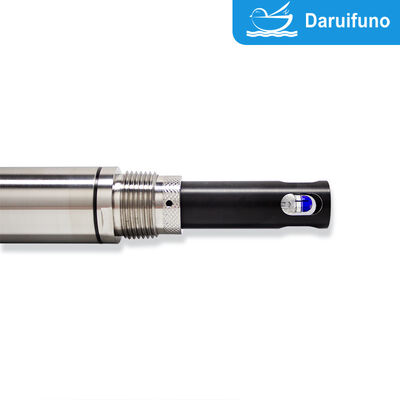
Product Overview
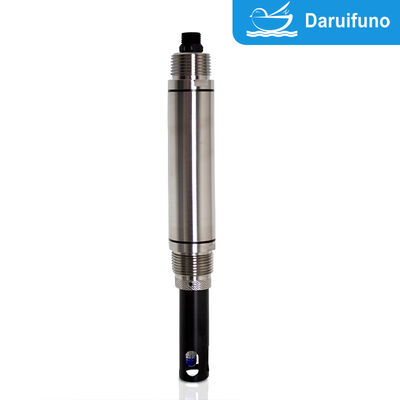
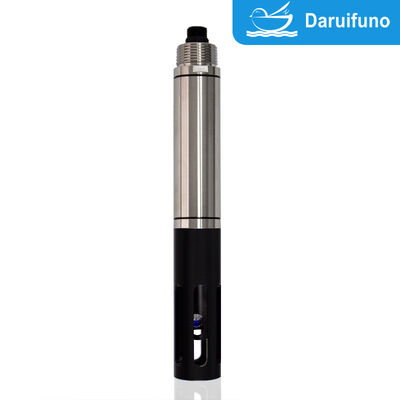
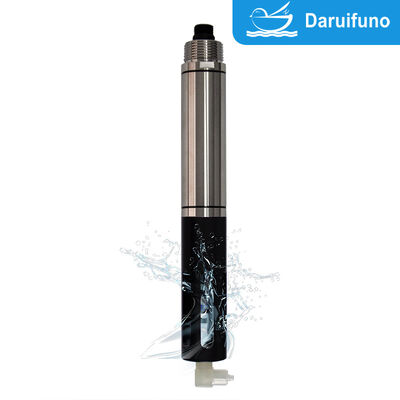
The DPH890 is a digital online pH sensor built on the glass electrode method. A pH-sensitive glass bulb develops a potential that follows the hydrogen ion activity of the water, a reference half-cell supplies a stable comparison potential, and the electronics inside the stainless steel 316 and POM body convert the difference into a temperature-compensated pH value before sending it out over RS485 Modbus RTU. Nothing in that chain depends on a separate transmitter, a screened analog cable or an external temperature probe.
The measurement specification is the part most engineers check first, so here it is in plain terms. The span is 0.00~14.00 pH with 0.01 pH resolution. Accuracy is stated as 0.1% of the measuring range or ±0.02 pH, whichever is larger, and the temperature channel is 0.0~50.0 °C with ±0.5 °C accuracy. That accuracy statement matters: at the low and high ends of the scale the percentage term dominates, which is the honest way to specify a glass electrode rather than quoting a single best-case number.
Calibration is deliberately flexible in controller. Three calibration points are supported — by default 4.01, 6.86 and 9.18 pH — and each point value can be edited inside a permitted window (3.5~4.51 pH, 6.36~7.5 pH and 8.68~10.5 pH) so you can calibrate with the buffers you actually keep in stock. Zero point, slope 1, slope 2 and a separate main measurement offset are all individually adjustable, which lets a maintenance team compensate for normal electrode ageing instead of replacing the sensor early.
The DPH890 is a digital online pH sensor built on the glass electrode method. A pH-sensitive glass bulb develops a potential that follows the hydrogen ion activity of the water, a reference half-cell supplies a stable comparison potential, and the electronics inside the stainless steel 316 and POM body convert the difference into a temperature-compensated pH value before sending it out over RS485 Modbus RTU. Nothing in that chain depends on a separate transmitter, a screened analog cable or an external temperature probe.
The measurement specification is the part most engineers check first, so here it is in plain terms. The span is 0.00~14.00 pH with 0.01 pH resolution. Accuracy is stated as 0.1% of the measuring range or ±0.02 pH, whichever is larger, and the temperature channel is 0.0~50.0 °C with ±0.5 °C accuracy. That accuracy statement matters: at the low and high ends of the scale the percentage term dominates, which is the honest way to specify a glass electrode rather than quoting a single best-case number.
Calibration is deliberately flexible in Daruifuno pH controller . Three calibration points are supported — by default 4.01, 6.86 and 9.18 pH — and each point value can be edited inside a permitted window (3.5~4.51 pH, 6.36~7.5 pH and 8.68~10.5 pH) so you can calibrate with the buffers you actually keep in stock. Zero point, slope 1, slope 2 and a separate main measurement offset are all individually adjustable, which lets a maintenance team compensate for normal electrode ageing instead of replacing the sensor early.
Signal conditioning is configurable too in the pH controller . The sampling buffer can be set to level 2, 4, 8, 16 or 32, so the same sensor can give a fast response in a dosing line or a smoothed reading in a basin with surface agitation. Power and communication are electrically isolated inside the sensor.
User Manual and Documentation
The DPH890 user manual (Version 1.0) is supplied with every sensor and issued as a PDF with the quotation on request. It contains the specification table, dimensional drawing, installation accessory list, wiring colour table, the complete Modbus RTU address map with data formats and initial values, worked command frames for reading values and for each calibration step, the maintenance cycle and a fault-finding table.
FAQ
Q1: What accuracy can I expect in real plant conditions?
The sensor is specified at 0.1% of the measuring range or ±0.02 pH, whichever is larger, with 0.01 pH resolution and ±0.5 °C on temperature. In service, the practical limit is usually the calibration and the condition of the glass bulb rather than the electronics, which is why monthly calibration checks are recommended.
Q2: Why are there three calibration points instead of two?
Two points define zero and slope, and the third point verifies linearity across the span. Having three points also lets you see when an ageing electrode is becoming non-linear, which is the earliest sign that replacement is due.
Q3: Can I calibrate with buffers other than 4.01, 6.86 and 9.18 pH?
Yes. Each calibration point value is editable inside a permitted window: 3.5~4.51 pH for point 1, 6.36~7.5 pH for point 2 and 8.68~10.5 pH for point 3. The default values are simply the most common buffers in water treatment.
Q4: What is the difference between automatic and manual temperature compensation?
Automatic mode uses the temperature element inside the sensor and corrects the pH slope continuously. Manual mode uses a fixed value you enter, which is appropriate when the process runs at a constant temperature or when you want to compare results against a lab measurement taken at a reference temperature.
Q5: Does the sampling buffer setting affect accuracy?
It affects response time and noise, not the calibration. Higher buffer levels average more samples, which quietens a rippling basin; lower levels respond faster, which suits dosing control. Choose the level that matches the process, not the one that produces the prettiest trend.
Q6: What happens if the electrode ages?
Slope falls and response slows. You can trim zero point, slope 1, slope 2 and the main measurement offset within the published ranges to keep the reading aligned, but once the slope drops below roughly 85% of nominal the electrode should be replaced.
Q7: Where can I get the DPH890 user manual and register map?
Ask our sales engineer. The user manual PDF, the register map and the dimension drawing are released for evaluation so your team can review wiring, protocol and mounting before ordering.
Ordering Information
Model DPH890, digital pH sensor, stainless steel 316 and POM body, RS485 Modbus RTU, 10 m cable. Please confirm cable length, connection method (separate cable or aviation plug) and which installation accessory set is required (side wall, top flange, flow-through, submerged or pipeline). Advise your process temperature, pressure and pH range and our engineer will confirm the configuration.


 Your message must be between 20-3,000 characters!
 English