What Is a Digital pH Sensor? DPH790 RS485 Modbus pH Probe Explained
If you are comparing pH measurement options for a water treatment or industrial process, you have likely come across the term digital pH sensor. This guide explains what it means and how the Daruifuno DPH790 puts the concept to work.
Digital vs. Analog pH Sensors
A traditional analog pH probe sends a very high-impedance millivolt signal that must be routed to a separate transmitter, where it is amplified, temperature-compensated and converted to a pH value. A digital pH sensor performs measurement and processing inside the electrode itself and outputs a clean digital value. The result is simpler wiring, better noise immunity and easier integration.
How the DPH790 Works
The DPH790 uses the proven glass electrode method to measure pH from 0.00 to 14.00 and temperature from 0.0 to 50.0 °C, with accuracy of 0.1% FS or ±0.02 pH. Temperature compensation is automatic, and power and communication are electrically isolated inside the sensor to protect signal integrity.
Digital Output Over RS485 Modbus
| Parameter |
Address |
Format |
| pH value |
2 |
32-bit float |
| Temperature value |
4 |
32-bit float |
Data is exchanged with a host using standard function codes, so the sensor drops straight into a Modbus network alongside other instruments.
Why Choose a Digital Sensor?
- No separate transmitter is required, saving panel space and cost
- Digital transmission resists electrical noise over long cable runs
- Automatic internal temperature compensation improves accuracy
- Calibration, addressing and reset can all be done over Modbus
- IP68 PPS construction supports immersion and humid environments
Typical Applications
Digital pH sensors are widely used in wastewater treatment, drinking water and purified water systems, surface water monitoring, circulating water, electroplating, chemical, food and pharmaceutical production.
Where Digital pH Sensors Are Used
Because they combine accurate measurement with simple integration, digital pH sensors are found across the water industry, including:
- Municipal and industrial wastewater treatment
- Drinking water and purified water plants
- Surface water and pollution source monitoring
- Circulating and cooling water systems
- Electroplating, electronics and printing & dyeing
- Chemical, food and pharmaceutical processes
In each setting, the sensor's automatic compensation and digital output help operators keep processes within specification while reducing wiring and maintenance effort.
About Daruifuno
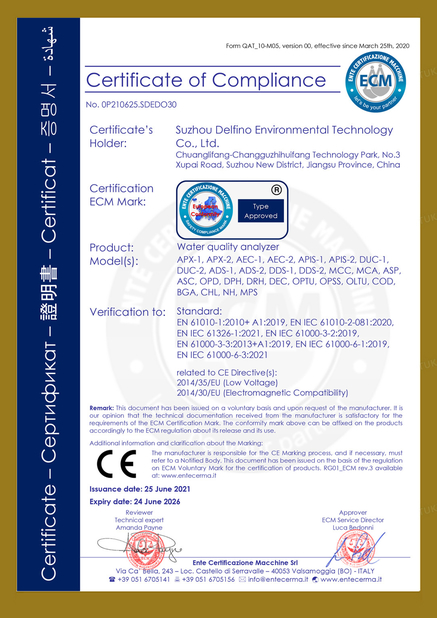
Suzhou Delfino Environmental Technology Co., Ltd. designs and manufactures water analysis instruments and sensors, supplying online, portable and laboratory products to customers worldwide since 2015.
Contact Daruifuno to discuss whether the DPH790 digital pH sensor is right for your project.


 Your message must be between 20-3,000 characters!
 English