How to Calibrate a Conductivity Analyzer: AEC1-T1 T2 1-5 Point Calibration Guide
Accurate calibration keeps conductivity readings trustworthy. This guide explains how to calibrate the Daruifuno AEC1-T1 T2 online conductivity analyzer, which supports both deviation & factor correction and 1–5 point linear calibration.
Before You Start
Connect the electrode and enter its actual cell constant (K constant) in the probe settings. This ensures the meter starts from a correct baseline. Prepare 1 to 5 water samples with known conductivity values and sort them from low to high.
Option 1: 1–5 Point Linear Calibration
- Clean the electrode with deionized water and dry it with filter paper.
- Place it in sample 1 (lowest conductivity) and wait for the reading to stabilize.
- Enter “1st point CAL”, set the value to sample 1's conductivity, and confirm.
- Repeat with sample 2, sample 3 and so on, cleaning and drying between samples.
- For one-point calibration use point 1; for five-point calibration use points 1–5 in order.
Temperature and TDS Coefficients
Since the display refers to 25 °C, set the temperature compensation coefficient for your water. If you need TDS, set the TDS coefficient, where TDS = conductivity (µS/cm) × coefficient. NTC10K or PT1000 sensors provide automatic compensation.
Frequently Asked Questions
How many calibration points are supported?
From one to five, using linear calibration in ascending conductivity order.
Do I need to re-enter the cell constant each time?
No — enter the actual K constant once in the probe settings.
What accuracy can I expect after calibration?
Conductivity accuracy of ±1% FS and temperature accuracy of ±0.5 °C.
Best Practices for Calibration
Always use fresh standard solutions and keep them at a stable temperature. Rinse the electrode with deionized water and blot it dry between samples to avoid carry-over. Record the calibration date and result for traceability, and re-calibrate whenever readings seem inconsistent. Well-maintained electrodes and careful technique ensure the analyzer delivers the ±1% FS accuracy it is capable of over its full working life.
About Daruifuno
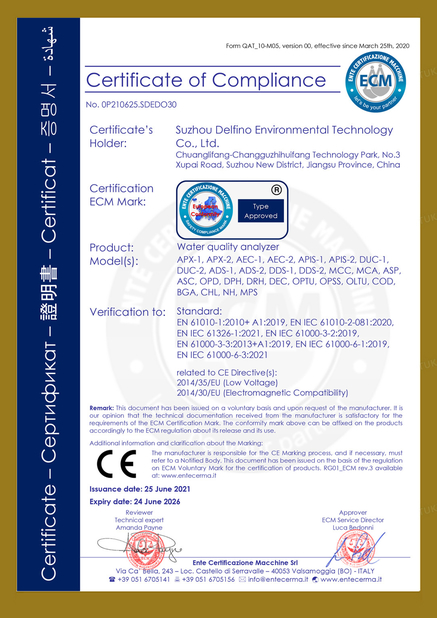
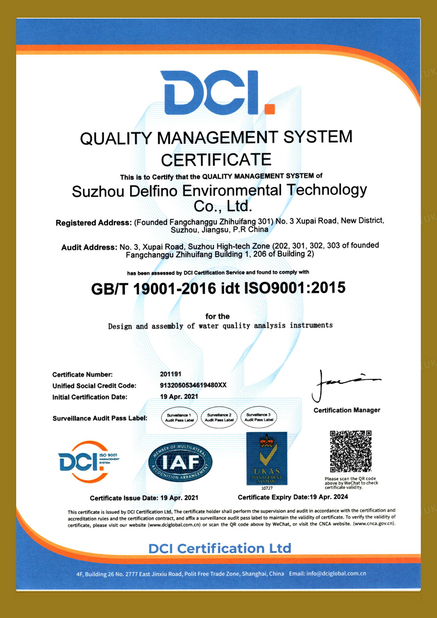
Suzhou Delfino Environmental Technology Co., Ltd. designs and manufactures water analysis instruments and sensors, supplying online, portable and laboratory products to customers worldwide since 2015.
Contact Daruifuno for calibration solutions, electrodes and controller bundles.


 Your message must be between 20-3,000 characters!
 English